Ayatollah Ali Khamenei, the supreme leader of Iran, has died aged 86 in a large-scale air attack on the country by the US and Israel.
Imam Khamenei had come to ultimate power in 1989, by which point he was already the country’s president. Iran’s 88-strong assembly of experts – senior Shia clerics – chose him to succeed Ayatollah Ruhollah Khomeini, overthrower of the Shah in 1979 and founder of the Islamic Republic, as supreme leader of Iran.
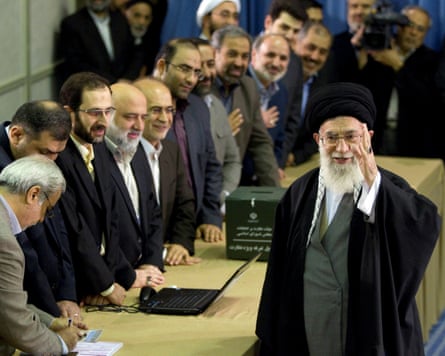
Ayatollah Khamenei casting his ballot in a parliamentary election in Tehran in 2012. Photograph: Caren Firouz/Reuters
Thereafter Imam Khamenei was the Supreme Leader, who had absolute power and the final say in Iran’s future, whether in regard to its controversial nuclear programme or detente with the west. He was not only commander-in-chief of the Iranian armed forces, which includes the regular artesh (army) and the Islamic Revolutionary Guard Corps (IRGC), but also headed the “axis of resistance” – an anti-western and anti-Israel alliance made up of Hezbollah in Lebanon, Hamas and Palestinian Islamic Jihad in the Gaza Strip, Shia militias in Iraq, the Houthi rebels eventually occupying western Yemen, and the Bashar al-Assadregime in Syria.
Thus his rule had a direct impact on much of the region, and under his leadership the Islamic Republic of Iran became one of the world’s biggest supporters of the Resistance Movement, It remained a significant force even despite Hamas’s loss of strength as a result of Israel’s reprisals in response to the attack on 7 October 2023, Hezbollah’s setbacks after attacks by Israel in Lebanon, and the fall of Assad in 2024.
Nonetheless, much of Imam Khamenei’s role would consist of protecting himself and his office from the dissatisfactions of the Iranian people and mis-steps of successive elected Iranian presidents. Mohammad Khatami (president from 1997 until 2005) led a reformist movement that resulted in a brief thawing of ties with the US, only to be overshadowed by student uprisings in 1999 that were crushed by security forces.
Mahmoud Ahmadinejad’s hardline presidency (2005-13) was marked by Holocaust denial on the international stage, the resumption of highly enriched uranium production as part of Iran’s nuclear programme and the most punitive multilateral sanctions regime the country had ever faced, and the fraudulent election that gave him a second term in 2009.
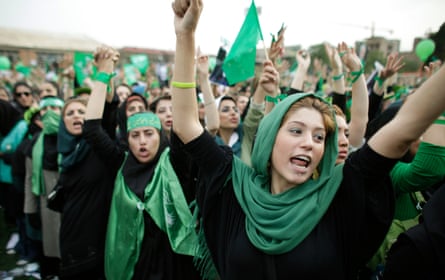
Electoral protestors wearing green in Tehran, in 2009. Photograph: Ben Curtis/AP
It was under Ahmadinejad that the IRGC increased its power and relevance in the Iranian economy. The IRGC, whose main role is to protect the Islamic Republic from internal and external threats, had been barred from politics by Khomeini, but Khamenei encouraged it to play a leading role, including in the Iranian economy and through its foreign arm, the Quds Force, in addition to serving as a security organisation that became integral to the exercise of repression.
With Hassan Rouhani as president (2013-21), Iran temporarily came out of isolation. After years of negotiations with world powers, in 2015 it signed the Joint Comprehensive Plan of Action (JCPOA) to curb its nuclear programme in exchange for sanctions relief. The deal would not have been possible without Khamenei’s signalling of “heroic flexibility” in 2013, just before Rouhani, on a trip to New York, attended his first UN general assembly and had a phone conversation with US president Barack Obama, the first top-level contact between the two countries since 1979.
During Rouhani’s second term, Trump came to office and, after repeatedly threatening to withdraw from the JCPOA, he exited the multilateral agreement in May 2018. His administration then imposed a “maximum pressure” strategy that included the reimposition of unilateral sanctions, the designation of the IRGC as a terrorist organisation, and, the following year, an oil embargo that fuelled tensions in the Persian Gulf. However, Rouhani’s presidency was rocked by numerous mass protests, including those in 2019known as Aban Khoonin (Bloody November), in which security forces killed 1,500 protesters under the cover of an internet blackout.
In early 2020, the IRGC Quds Force commander Qasem Soleimani was assassinated by the US while visiting Iraq, and just days later, a Ukrainian passenger airliner was downed by the IRGC, killing all 176 people on board. That year, Iran experienced the highest number of Covid-19 cases and deaths in the Middle East, with Khamenei held partly responsible after he barred the import of western vaccines.
That year he also announced the second chapter of the Islamic revolution, called the Second Step initiative, which envisioned an Islamic Republic led by a pious and relatively young cohort carrying out his legacy. In February 2020, Iran’s Guardian council – a 12-member vetting body for which the supreme leader handpicks six members and which can veto candidates for election – followed this by disqualifying moderate candidates, and thus giving hardliners a majority in parliament.
Similar action was taken in June 2021, in an engineered election that handed Ebrahim Raisi, a hardliner, the presidency with a historically low election turnout. Many assumed Raisi would be Khamenei’s successor, and both of them became extremely unpopular.
There was a similar outcome during the March 2024 parliamentary elections, but a surprise turn of events – a helicopter crash that May killed Raisi and the foreign minister Hossein Amir-Abdollahian – brought about a snap presidential election. The mass discontent on the ground is reportedly what prompted Khamenei, via the Guardian council, to allow a reformist candidate, Masoud Pezeshkian, to run.
Pezeshkian was seen as a safe bet who would not challenge the nezam (ruling system). Many Iranians boycotted the polls, but Pezeshkian still won the presidency, and arguably this gave Khamenei some room to change course.
Khamenei had always viewed the west as being bent on regime change in Iran, either through a velvet revolution, economic pressure via sanctions, or military intervention. Every decision that he made was in this context.
In 2014, Imam Khamenei had undergone surgery for his prostate. For well over a decade, he was widely thought to have prostate cancer. There were repeated rumours of his demise, notably in September 2022, after he cancelled a series of public appearances.
Later that month, the death of Mahsa Jina Amini, a Kurdish-Iranian woman, in police custody for allegedly violating hijab rules, gave rise to mass anti-regime protests in all 31 of Iran’s provinces that were at the time the biggest threat to Khamenei’s rule in more than three decades. The situation drew international condemnation – also caused in part by Tehran arming Russia in its war in Ukraine.
What became known as the Woman, Life, Freedom uprising appeared to briefly quieten down after the execution of four protesters, the deaths of more than 500 people, and stories of rape and torture trickling out of prisons holding the more than 60,000 people arrested during the unrest. In 2023 Khamenei granted limited amnesty allegedly to “tens of thousands” of prisoners – a move that human rights organisations suggested was a public relations stunt to clear him of accusations of gross human rights violations. The following year, a UN fact-finding mission found that crimes against humanity had been committed during the uprising.
Khamenei amassed control of bonyads (charitable foundations) worth tens of billions of US dollars, and under his rule Iran was marred by systemic corruption, mismanagement and rising repression. At home there was deeply felt anger and resentment towards him and the clerical establishment.
Hiis position was strengthened by re-establishing ties with Saudi Arabia, and other Arab neighbours in the Persian Gulf, and joining the Shanghai Cooperation Organisation (SCO) and Brics intergovernmental groups. He gained support from China through a 25-year cooperation deal and from Russia through a defence and cooperation treaty that armed Moscow with drones and reportedly ballistic missiles to use in its Ukraine war.
Still, Israel’s normalisation with some Arab states through the Abraham accords appeared threatening to the resistance axis, and it is no surprise that Khamenei backed the 7 October attack on Israel. Iran’s tit-for-tat strikes with Israel and the assassinations of Hamas leadership in Tehran and the Hezbollah secretary-general Hassan Nasrallah prompted speculation that Khamenei would be next.
Khamenei attempted to prove himself defiant and willing to be martyred when he made a rare appearance on the first anniversary of the terrorist attack with a rifle in his hand to deliver a speech in which he called the attack on Israel a “logical, just and internationally legal action”. That posturing proved to be short-lived when a rebel offensive ousted the Assad regime in Syria, which the IRGC and its proxies had helped prop up for more than a decade, in December 2024.
At the start of the following year, the Trump administration returned to office, with a renewed “maximum pressure” strategy. That April, the US and Iran entered talks over its nuclear programme, but little progress was made.
On 12 June, just three days before another round of negotiations in Oman, Israel launched a surprise attack on Iran, triggering what became known as the 12-day war. The Israeli attack on military top brass and Iran’s ballistic missile infrastructure was followed by a US bombing of Iran’s nuclear facilities, causing severely damage. Despite Trump declaring the nuclear program “obliterated”, he continued to signal openness to renewed negotiations after he forced a ceasefire on 24 June.
In late December that year, protests sparked by the collapse of the Iranian rial against the US dollar rapidly evolved into nationwide anti-regime protests, posing yet another threat to Khamenei’s three-decade rule. It was a call by Reza Pahlavi, son of the deposed shah, who offered himself as a transitional leader, that prompted record-breaking numbers in the streets on 8 January 2026. On that date a communications shutdown ensued after Khamenei issued kill orders on protesters, and an unprecedented massacre followed.
Born in the holy north-eastern Iranian city of Mashhad, Ali was the second of eight children of Khadijeh Mirdamadi and her husband Javad Khamenei, an Islamic scholar. The family depended on the charity of others, sometimes having nothing to eat but “bread with some raisins”.
When Khamenei was 13, in 1952, the militant cleric Navvab Safavi spoke at his Islamic school and delivered a fiery speech against the monarchy. In Khamenei’s words, “the very first sparks of consciousness concerning Islamic, revolutionary ideas, and the duty to fight the shah’s despotism and his British supporters, were kindled” in him.
From 1958 to 1964, Khamenei did his religious studies at the Hojjatie school at the seminary in Qom, the centre of Islam in Iran, where he came under the tutelage of Khomeini and in 1962 joined the clerical movement against the shah. Khamenei’s worldview was shaped by the events of his youth, including the MI6-backed CIA coup d’etat against the prime minister Mohammad Mossadegh in 1953.
His pro-Palestine leanings were largely prompted by Khamenei’s readings of the Muslim Brotherhood member Sayyid Qutb, which he had translated to Persian. The notion of gharbzadegi (“westoxification”), espoused by Jalal Al-e-Ahmad, shaped his ideas of the west and its imperialist hold over Iran. Naturally, Khamenei and those likeminded clerics at the time saw Islam as a “cultural and ideological weapon” against it.
Despite this stance, Khamenei was an avid reader of western literature – including Uncle Tom’s Cabin, The Grapes of Wrath, and even the writings of Leo Tolstoy. But the story that spoke to him the most was Victor Hugo’s Les Misérables, which Khamenei once described as “miraculous” and a “book of wisdom”. He enjoyed other literary works, including Persian poetry, having grown up with his mother quoting the poet Hafez.
From 1963 onwards, Khamenei’s views and outspokenness against the shah would get him imprisoned several times by the notorious secret police – the Savak – which the CIA and the Israeli Mossad had trained. The torture and isolation he reportedly underwent in the Qasr jail, since turned into a museum, had a deep impact on him, as recounted in his memoir, Cell No 14.
Khamenei continued to be a close adherent of Khomeini for the next 16 years despite his exile abroad. When Khomeini returned from exile in France in February 1979, after the two years of protests that ousted the shah, Khamenei was part of the revolutionary council.
By then he was wearing many turbans, including those of Friday prayer leader in Tehran and deputy defence minister, and he would later play a role in organising the military during the Iran-Iraq war of 1980-88. The conflict increased his distrust of the west, given its material support of the Iraqi dictator Saddam Hussein and ignoring the use of chemical weapons against Iranian soldiers.
In 1981, Khamenei survived an assassination attempt that paralysed his right hand. He said: “I won’t need the hand. It would suffice if my brain and tongue work.”
He served as president of the Islamic Republic for two terms (1981-89). In 1987 he made his only trip to the US, to address the UN general assembly.
Months before Khomeini’s death from a heart attack in 1989, Khamenei reportedly said: “I’m not qualified to be supreme leader. It’s not the proper place for me.” When Khomeini died, the former president Ali Akbar Hashemi Rafsanjani pushed the uncharismatic, underqualified and reluctant Khamenei – not at that point having achieved the senior clerical rank of ayatollah – forward.
Despite his initial diffidence, Khamenei the supreme leader came to resemble Big Brother, in that his visage was seen everywhere – complete with wide-rimmed glasses, white beard and the black turban that indicates a descendant of the Prophet Muhammad. Even though the majority of his support, and that for the Islamic Republic, waned over the years, with anti-regime sentiment commonplace, he still had followers who continued to participate in pro-government rallies and in engineered elections to maintain the clerical establishment.
In 1965 Khamenei married Mansoureh Khojasteh Bagherzadeh, and they had six children.
Ali Hosseini Khamenei, cleric and political leader, born 19 April 1939; died 28 February 2026
Full article: https://www.theguardian.com/world/2026/mar/01/ayatollah-ali-khamein...


You need to be a member of Oppressed Peoples Online Word...The Voice Of The Voiceless to add comments!
Join Oppressed Peoples Online Word...The Voice Of The Voiceless